Red Fox Communication

Nolan O'Connor
| 18-03-2026
 · Animal Team
Imagine walking through a quiet woodland at dusk and suddenly hearing a series of sharp barks, shrill yelps, and odd chattering sounds.
These aren't random noises—they are part of a rich language used by one of nature's most adaptable mammals: the red fox.
Communication is essential to a red fox's life, helping it mark territory, stay in contact with others, and navigate social relationships. Their communication system is far more complex than most people realize.
Vocal Signals: A Symphony in the Wild
Red foxes rely on a broad repertoire of vocalizations to share information across distances. Their calls range from sharp barks to prolonged shrieks, each serving a specific purpose. These sounds are especially useful during the night when foxes are most active.
A short, sharp bark often functions as a long distance contact call, helping separated mates or family members stay aware of each other's location. Other vocalizations include high pitched yelps, whines, and screeches that can indicate excitement, warning, or even disturbance. This variety allows foxes to convey different messages depending on context.
These vocal signals are not only about alerting others to presence or danger—they also reflect internal states. For example, certain calls may indicate agitation or alertness, while softer sounds may be used during close interaction with kin or littermates.
Scent Marking: Invisible Messages
While fox sounds can be striking, an equally important part of their communication lies in scent. Red foxes use chemical signals to mark territory and announce identity. Special glands near the base of the tail produce substances that aid in individual recognition, while scent deposits and feces left along trails or around a den act as invisible signs for other foxes.
These scent markers accomplish several important tasks. They define boundaries, reducing the likelihood of physical encounters. They also indicate social status and reproductive condition, signaling to others when a fox is ready to mate or when a territory is occupied.
Because these scent trails remain after the fox has moved on, they serve as a long lasting form of communication that works even when individuals are not in sight or sound.
Body Language: Subtle Signs of Social Interaction
Voice and scent tell only part of the story. Red foxes also rely on visual cues—body language and posture—to communicate in close proximity. Ritualized gestures, movement patterns, and positions of the ears and tail provide a sophisticated set of signals.
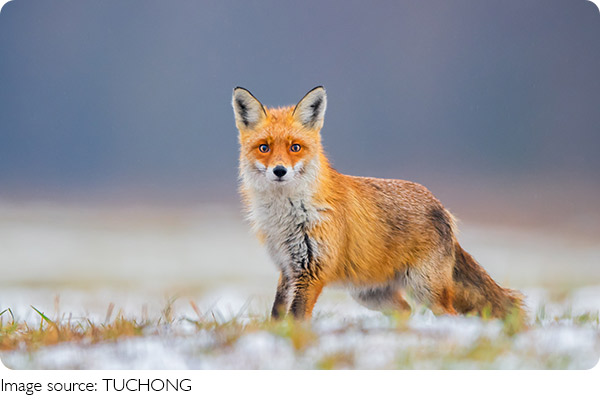
For instance, a fox standing upright with its tail held high may be asserting confidence or dominance, while lowered posture and flattened ears are indicators of submission. These visual signals help prevent misunderstandings and reduce conflict by allowing individuals to “read” one another's intent without physical confrontation.
This blend of signals is especially important in social situations involving family groups, mates, or neighboring foxes.
Social Bonds Through Communication
Red foxes are often described as solitary hunters, but their communication systems highlight a more complex social dimension. They form long term social bonds, especially between mates and within family groups. Vocalization, scent, and body language work together to maintain these bonds.
When foraging alone during the day, these animals still rely on scent and occasional calls to maintain connections with partners or offspring. During the breeding season, communication increases dramatically as foxes court, coordinate den use, and care for young.
These signals help manage social relationships, resolve disputes, and synchronize behavior within the group. It's a subtle but highly effective system that promotes cohesion without constant physical proximity.
The Complexity Beneath the Calls
Red fox communication is a multilayered system that reflects their intelligence and adaptability. From nocturnal barks that traverse open fields to invisible scent trails etched into the landscape, their language allows them to navigate a world filled with competitors, family, and changing environments.
We often think of wildlife communication as simple or instinctive, but in red foxes we find a nuanced network of sounds, signs, and scents. Listening more closely reminds us that even the quietest corners of nature are filled with conversation, relationships, and connections—if we know how to interpret them.