Night Driving: Beat Glare

Naveen Kumar
| 07-09-2026
 · Vehicle Team
Lykkers, bright headlights can temporarily overwhelm our vision and make an otherwise routine nighttime journey more demanding.
The safest response is to remain composed, adapt to the available visibility, and give ourselves enough time to recognize changes on the road.
Stay Steady
When intense headlights approach, avoid sudden steering, braking, or acceleration. Keep the vehicle in its lane and concentrate on the roadway rather than reacting emotionally to the glare.
There is no benefit in responding with equally bright lights. Maintaining a smooth, predictable course allows the situation to pass without creating additional distraction.
Slow Down Smoothly
Glare can temporarily obscure lane markings, road edges, curves, pedestrians, cyclists, and other objects. If these details become difficult to identify, ease off the accelerator and reduce speed gradually.
Extra caution is particularly useful near bends, intersections, narrow sections, and areas with limited lighting. Choose a speed that allows you to see and respond comfortably within the distance ahead.
Look Beyond the Headlights
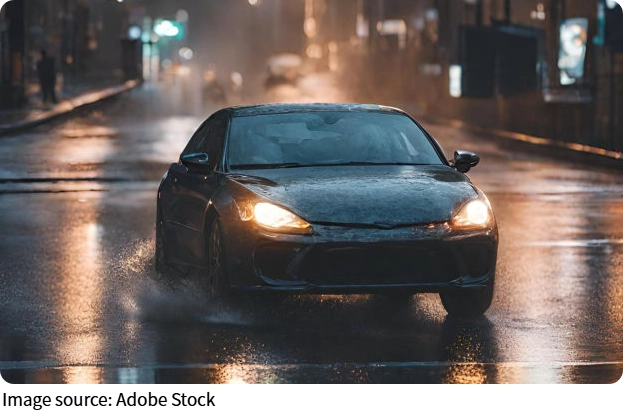
Avoid staring directly into an approaching light source. Instead, keep your gaze directed toward the roadway and a safe reference point ahead while remaining aware of surrounding traffic.
This helps prevent the glare from becoming the main focus of your vision while allowing you to maintain lane awareness.
Control Reflections
Headlights from vehicles behind can create distracting reflections in the interior mirror. If your vehicle has a night setting, use it to reduce reflected light.
Adjust the side mirrors according to the vehicle's instructions and keep them positioned correctly. Proper mirror use can reduce unnecessary reflections while preserving awareness of nearby traffic.
Create More Space
When visibility is temporarily reduced, increase the distance from the vehicle ahead. Additional space provides more time to recognize changes in traffic and respond smoothly.
Continue scanning the road for lane markings, intersections, signs, road edges, and other vehicles. A broad view of the driving environment is more useful than concentrating on one source of light.
Eliminate Distractions
Do not use a phone to photograph or record a vehicle with bright headlights. Handling a device takes attention away from driving at precisely the moment when careful observation matters most.
If a dashboard camera is already operating, it can record the journey without requiring any interaction. Any follow-up should be handled after driving and through appropriate local procedures.
Stop if Visibility Becomes Unsafe
If glare is combined with rain, fog, fatigue, or another condition that makes the roadway difficult to see, consider taking a break at a safe and permitted location.
Wait until conditions improve before continuing. Never make an abrupt stop or pull over somewhere that could create a hazard for yourself or other road users.
Final Thoughts
Bright headlights are an unavoidable part of nighttime traffic, but they do not have to determine how we drive. Staying steady, reducing speed when visibility decreases, looking beyond direct glare, managing reflections, increasing space, and eliminating distractions all support safer decision-making.
Lykkers, the key is simple: when visibility changes, adapt your driving to match it. A calm response gives you more time to see, decide, and act safely.